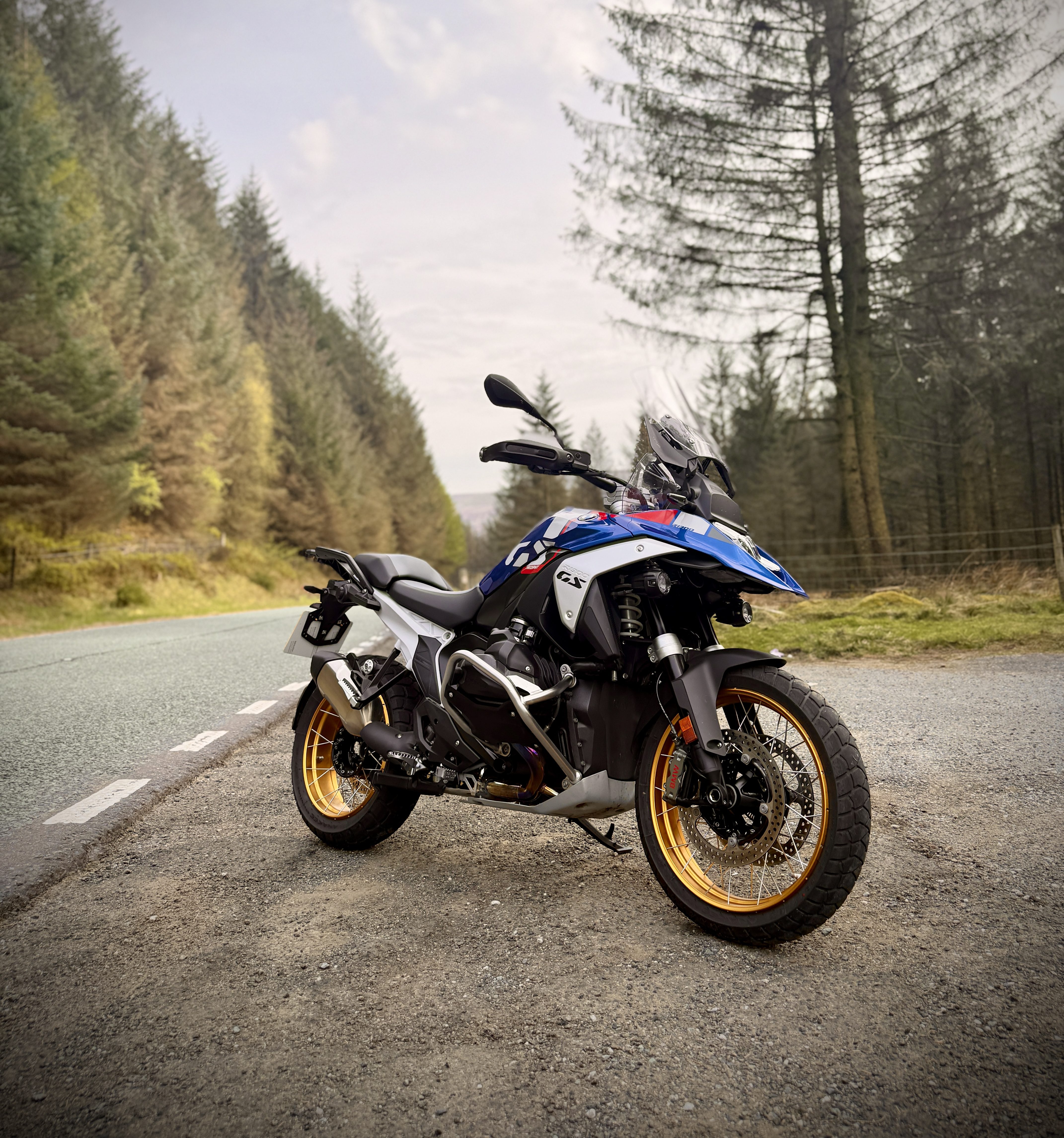
The first couple of weeks with the BMW R1300GS have been a genuine learning curve, largely down to the ASA gearbox. Riding a motorcycle without a clutch doesn’t come naturally at first. It’s something most riders are conditioned to rely on, so taking it out of the equation feels slightly unfamiliar. That said, the system proves itself quickly once you begin to understand how it prefers to be ridden.

I’d already spent some time with ASA on the R1300RT, where it stood out as a particularly useful addition. The ability to run in fully automatic or semi-manual mode, all without a clutch, made riding feel notably easier – especially in traffic or on longer journeys where fatigue can creep in. That same core benefit is present on the GS, although the experience here feels a little more nuanced.
Early impressions haven’t been entirely flawless. The most noticeable trait has been a degree of clunkiness in the lower gears. At slower speeds, particularly in town or when filtering through traffic, gear changes can feel slightly abrupt. Depending on the riding mode, there are also moments where the bike seems to hesitate while deciding on the right gear. At times, it can also settle in a ratio that feels a touch too high, especially when approaching or exiting a bend.
Initially, it’s easy to see this as a shortcoming. In reality, it’s more about how you approach the bike.
Out of habit, I found myself expecting the gearbox to behave like a traditional manual setup – shifting where I would normally choose to shift. The ASA system doesn’t work like that. Instead, it responds closely to throttle input. You need to adapt your riding style slightly, learning when to roll on or ease off in order to encourage the bike to change gear. Engine braking also becomes something you manage more consciously, rather than something that naturally follows your own gear selection.
It’s not a dramatic shift from conventional riding, but the finer details matter. Smooth riding in the fully automatic mode requires a bit more thought and a bit more finesse. There’s a layer of technique involved that you don’t typically consider on a standard manual bike.
When it all comes together, though, the bike feels superb. The R1300GS settles into a smooth, composed rhythm and covers ground with ease. It flows along effortlessly, feeling stable and refined in a way that suits long-distance riding perfectly.
In terms of capability, it’s exactly what you would expect from a Gelände / Straße. It’s a highly versatile machine, built to handle both road and off-road use with confidence. For my own riding, it will spend the vast majority of its time on tarmac, and it’s set up with that in mind. On the road, it holds its own comfortably against my previous Tiger 900 in terms of handling, which is impressive for a big adventure bike. The performance is there from the 1300 boxer engine, but getting the very best from it requires a slightly more considered approach, particularly with the ASA system in play.
That process of adaptation has actually been one of the more enjoyable aspects so far. There’s something satisfying about refining your inputs and working towards a smoother, more controlled ride. It becomes a personal challenge – how fluid you can make each journey, how well you can work with the bike rather than against it.

Adjustments Incoming
A few small adjustments are in progress. I’m currently waiting on parts from BMW to lower the handlebars slightly. The bike came fitted with the Enduro package, which includes bar risers designed to improve control when riding off-road. For road use, they sit a little higher than I’d prefer, so lowering them should improve feel through the front end and give a more connected riding position.
Fixing the leaking R1300GS Forks
On the reliability front, an initial issue with the 1300GS’ leaking fork seals has now been resolved under warranty, which is reassuring. With that sorted, I can now focus on spending more time getting to know the bike properly.


Final Thoughts
Overall, despite the early hiccup with the fork seals, it’s been a genuinely positive start with the BMW R1300GS. The ASA system is really at the centre of that experience. It’s not something that feels completely natural from the outset, and that’s important to acknowledge. If you jump on expecting it to behave exactly like a traditional manual gearbox, it can feel slightly out of step – occasionally hesitant, sometimes a bit clunky, and not always in the gear you might instinctively choose.
But the more time you spend with it, the clearer it becomes that ASA isn’t trying to replicate a manual gearbox – it’s offering a different way of riding altogether.
Once you begin to trust the system and adapt your inputs, it starts to make a lot more sense. Throttle control becomes your primary tool, subtly guiding the bike’s decisions rather than directly dictating them. You learn when to ease off to encourage a downshift, when to hold steady for a smooth upshift, and how to use engine braking more deliberately. It adds a layer of involvement that’s different, but not lesser.
What stands out is how the ASA system reduces workload in the background. In slower traffic, it takes away the constant clutch work. On longer rides, it removes that low-level fatigue you don’t always notice building up. At the same time, it still allows you to stay engaged with the ride.
There’s a balance to it. It won’t suit everyone straight away, and some riders may never fully warm to the idea of a clutchless GS. But if you’re willing to meet it halfway, the system starts to shine. The ride becomes smoother, more fluid, and arguably more relaxed without losing that sense of control.
In many ways, that’s what defines the R1300GS with ASA. It’s not about instant familiarity – it’s about progression. The more you ride it, the better it feels, and the more it rewards a thoughtful, measured approach. It’s a different kind of connection between rider and machine, but one that becomes increasingly satisfying over time.
As they say in Germany…..Bisher alles gut. (So far, so good.)

Leave a Reply