There’s “sloppy”… and then there’s Peak District sloppy.
This particular ride took me onto a BOAT – a Byway Open to All Traffic – ironically a boat would have come in handy.
About halfway along, the trail turned into something far more tricky than expected. What lay ahead wasn’t just a puddle or a muddy stretch, but something closer to a bog.
As I approached, I made what seemed like a sensible decision at the time. The main route was completely covered in water, making it impossible to judge what lay beneath the surface. Rather than risk riding blind into it, I chose a rut off to the left that looked like a safer option.

Getting That Sinking Feeling
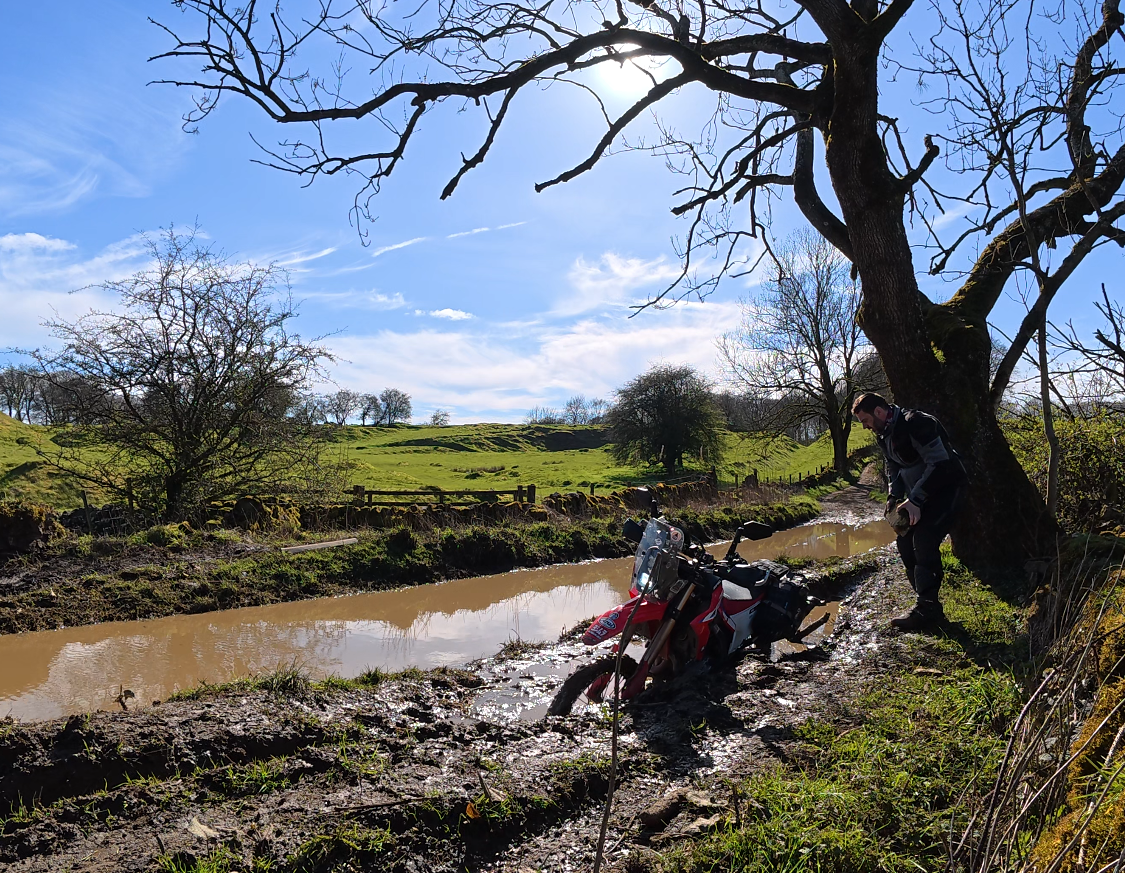
What I didn’t notice as I entered, was that this rut was connected to the main waterlogged section. So it was full of thick, heavy sludge as you can see above.
As I entered the rut, it didn’t seem too bad at first. The bike rolled in without much protest.
It was too late to turn back, I was committed. Then all of a sudden the bike stopped.
Not gradually. Not with a warning. It simply sank.
A few choice words were said, loudly and without much restraint.

Time To Get To Work
I got straight to work trying to free the bike. Pulling, pushing, rocking it back and forth – nothing worked. The mud was too thick, the water deeper than expected, and the sides of the rut too steep to get any proper leverage.
It quickly became clear that brute force alone wasn’t going to solve this. So I gave it a fist full of throttle as we all know that may work (although it never does).
I clearly needed a different approach.

Trail Riding Bushcraft
After a bit of searching, I found a large flat rock and dragged it over behind the front wheel. The idea was to raise the front end just enough to get it onto something solid, giving me a chance to pull the bike towards the bank.
It wasn’t easy. It took a fair bit of effort to move the bike back and forth until the front wheel finally climbed onto the rock. By this point, I was covered in mud and starting to feel shattered. Off came the jacket and I managed to lift and position the bike partway up the bank.
But that was as far as I could get.
I simply didn’t have the strength or leverage to finish the job on my own.

Contemplating My Options
Completely worn out, I took a break and sat on a nearby dry-stone wall, looking at the situation and weighing up my options. Leaving the bike crossed my mind, though it wasn’t something I wanted to seriously consider.
Thirty minutes went by then I heard the sound of other riders approaching. And just like that, four green laners came through one after another. The first rode straight through the water without hesitation. The second followed suit. At that point, more expletives were spoken, the main part of the water was not as deep as the bog I was stuck in.
At first, I think they thought I was taking a break, but I really needed them to stop. A few increasingly obvious gestures did the trick.
The last rider noticed and stopped.
Finally, it was time to get out of this sticky situation.

Three Is The Magic Number
With three of us lifting, my trusty CRF finally came free from its impromptu mud bath. There’s no chance I would have managed it alone.
As we pushed the bike to the safety and solidity of the gravel trail, there were a few jokes about not being able to recognise the bike under all the mud, which felt fair enough given the state of it.


Time To Take Stock and Grab a Brew
Once I was free, I carried on along my route and eventually reached Monyash, where I stopped for a well-earned cup of tea. That, of course, came with plenty of comments about the state of my bike – mostly from riders on spotless machines that had clearly spent the winter tucked away, dressed in clean leathers and blissfully unaware until now of the bumbling idiot who’d been wrestling with a muddy bog not long before.
Truth be told, I was more than happy to have had the experience. They may have looked spotless while I was covered head to toe in mud, but I was far more pleased to have come out the other side with a story to tell.

Lessons Learnt – What I Took From It
Looking back, there are a few clear lessons.
Riding straight through the water might have worked. Keeping your momentum is often the best tactic, but it’s never without risk. You’ve no real idea what’s lurking beneath the surface, and if water gets into the wrong parts of the bike, it can quickly turn into a much bigger problem.
If you’re riding in a group, there’s a bit more confidence in knowing help is on hand, so on another day I might have taken the chance. On my own, though, the last thing I wanted was to turn the bike into a canoe.
Turning around was technically an option, but in reality, it is one most riders are reluctant to take. Pride has a habit of getting in the way – usually just before it all goes wrong.
The biggest lesson was line choice. Sometimes it pays to stop, get off the bike, and walk the route for a short distance to properly assess your options. Had I done that, I’d have seen that the rut I chose dropped into the lowest part of the trail – exactly where all the water and sludge had gathered.
In hindsight, the higher line would almost certainly have been firmer and given me a much better chance of getting through cleanly. It might have been slightly awkward to get onto at the start, but that was before the water, so the worst-case scenario would have been a simple drop rather than getting completely bogged down.
Final Thoughts
Green-laning is hugely enjoyable, but situations like this are a good reminder that things can go wrong, particularly when riding alone. I was fortunate that this was a well-used route and that other riders came along when they did.
Moments like this also highlight what makes the motorcycling community what it is. People are willing to stop and help when it matters.
Of course, that help usually comes with a bit of humour at your expense afterwards, but that’s all part of it.
Finally, thanks to the guys that helped me out, I owe you one.

Leave a Reply