
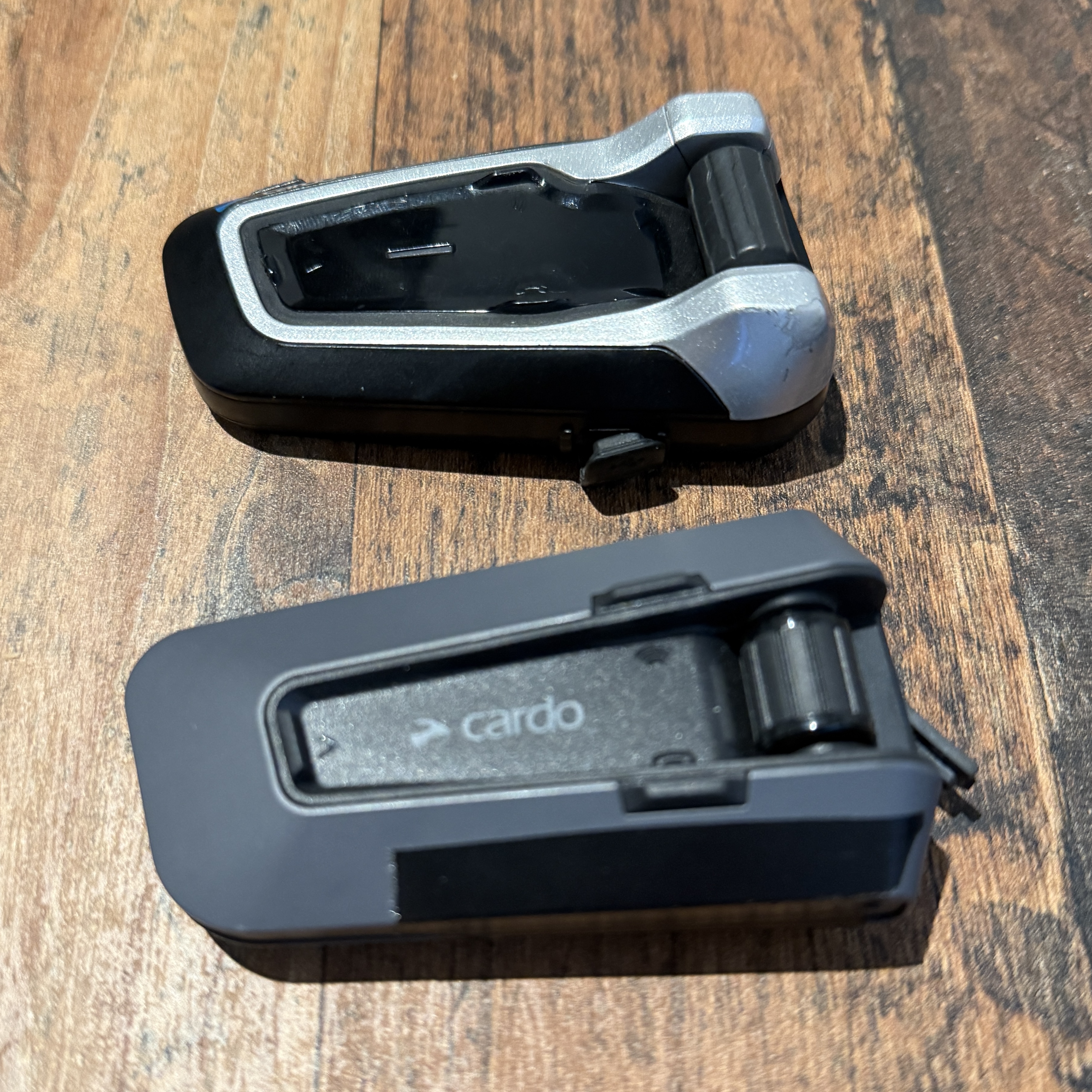
Cardo has long been a trusted name in motorcycle communication systems, and the Packtalk range has become a common sight on helmets across the UK. Riders who travel in groups or spend long days in the saddle often rely on these systems to stay connected, listen to navigation instructions, or stream music while riding.
Two of the most widely discussed models are the Packtalk Bold and the newer Packtalk Edge. Although they share many core features and the same overall philosophy, there are some important differences that may influence which model suits your riding style best.
This comparison focuses on how each unit performs in everyday use rather than simply listing specifications.

Design and Mounting
The Packtalk Edge introduces a more modern design compared with the older Bold. Its slimmer shape gives it a cleaner appearance on the side of the helmet and helps it sit a little more discreetly, particularly on newer helmet designs.
The biggest physical change is the mounting system. The Edge uses a magnetic cradle that allows the intercom unit to snap securely into place. Once attached it feels solid, even when riding at motorway speeds, and removing it when leaving the bike takes only a second.
The Packtalk Bold relies on a traditional slide-in mounting bracket. It works reliably, but the process is slightly slower and less convenient if you frequently remove the unit or swap it between helmets.
Controls and Everyday Use
Both intercoms use Cardo’s familiar control wheel alongside several physical buttons. This layout has been widely praised by riders because it is easy to operate while wearing gloves, even in colder conditions.
Anyone moving from the Bold to the Edge will immediately recognise the control layout, as the general interface remains largely unchanged. This makes the transition between models straightforward.
The Edge does introduce small improvements in responsiveness. Voice commands, which allow riders to control functions without touching the unit, tend to register a little more quickly. This can be particularly helpful when riding at speed or in windy conditions where voice recognition systems sometimes struggle.
Intercom Performance and Group Riding
Group communication is where the Packtalk series has always stood out. Both the Bold and the Edge use Cardo’s Dynamic Mesh Communication system, which allows multiple riders to stay connected without constantly reconnecting devices.
In practical terms, this means riders can drop in and out of range without disrupting the whole group. When someone falls behind or takes a different road for a moment, the system automatically reconnects them when they return within range.
Both models handle this process well and deliver clear communication between riders. The Edge does not dramatically change the experience, but it does feel slightly more refined. Reconnections tend to happen a little faster, and the overall connection stability feels marginally improved when riding in larger groups.
Audio Quality
Sound quality is strong on both intercoms. Voice communication is clear, and music playback is more than adequate for motorway riding.
The Packtalk Bold is often noted for its strong maximum volume. Some riders prefer this when travelling at higher speeds or when using helmets that allow more wind noise.
The Packtalk Edge takes a slightly different approach. Rather than focusing purely on volume, it offers a more balanced and refined sound profile. Spoken instructions from navigation apps and intercom conversations often sound a little clearer as a result.
Both units also include automatic volume adjustment, which raises or lowers the audio level depending on riding speed and surrounding noise.
Connectivity and Software Updates
One of the more significant technical differences between the two models lies in their connectivity.
The Packtalk Edge uses newer Bluetooth hardware, which can provide a more stable connection with modern smartphones and navigation apps. While the Bold still performs well, the updated wireless technology in the Edge offers a small but noticeable improvement in reliability.
Software updates are also handled differently. With the Edge, updates can be installed wirelessly using the Cardo Connect mobile application. This makes it easy to keep the device up to date without connecting it to a computer.
The Packtalk Bold generally requires a wired connection for firmware updates, which is still straightforward but less convenient.
Battery Life and Day-to-Day Practicality
Battery performance between the two models is broadly similar. Both are designed to last a full day of riding under typical conditions, which is sufficient for most touring or commuting scenarios.
Charging while riding is also possible, allowing riders to top up the battery using a power bank or motorcycle USB port during longer trips.
In everyday use, the practical differences between the two units are relatively small. Both deliver reliable communication, strong audio performance and straightforward operation.
Which One Should You Choose?
The Packtalk Bold remains a capable and dependable communication system. Riders who already own one will likely find little reason to replace it immediately, as it continues to perform very well for both solo and group riding.

The Packtalk Edge, however, adds several refinements that make the overall experience a little smoother. The magnetic mounting system, wireless updates and slightly improved connectivity all contribute to a more modern feel.

For riders who want the latest technology and the most convenient design, the Edge is the stronger option. For those looking for proven performance at a potentially lower price, the Packtalk Bold still represents excellent value.
Can Cardo Packtalk Edge or Packtalk Bold Connect to Sena Intercoms?
A common question among riders is whether Cardo and Sena communication systems can work together. The short answer is yes, but there are a few limitations depending on how the devices are connected.
Bluetooth Compatibility Between Cardo and Sena
Cardo intercoms include a feature commonly known as universal Bluetooth intercom. This allows them to pair with communication systems made by other brands, including Sena.
When paired in this way, the two units communicate through a standard Bluetooth intercom connection rather than through Cardo’s Dynamic Mesh Communication network. Once connected, riders can speak to each other just as they would with a normal rider-to-rider intercom connection.
This setup is typically used for direct communication between two riders using different brands of headset.
Limitations When Mixing Brands
Some of the more advanced features found in modern motorcycle intercom systems are not available when using a mixture of devices from different manufacturers such as Cardo and Sena.
The main limitation comes from mesh networking technology, which is designed to deliver the most stable and seamless communication for larger riding groups. Using the same brand of intercom across all riders generally provides the most consistent performance. However, in everyday riding situations this is not always possible, as riders often choose equipment based on personal preference, budget, or existing ownership.
Cardo’s Dynamic Mesh Communication system is built to work only with other Cardo units, while Sena’s Mesh Intercom technology is restricted to Sena devices. Because the two systems rely on different communication protocols, they cannot join together to form a single shared mesh network.
When mixed devices are used during group rides, Bluetooth pairing usually provides a practical solution for basic communication. Both the Cardo Packtalk Edge and Packtalk Bold can generally connect to Sena intercoms using standard Bluetooth intercom pairing. This approach works best for direct rider-to-rider conversations once devices have been paired correctly. With some preparation, mixed-brand groups can often stay connected, although performance and connection stability may vary depending on factors such as riding speed, surrounding terrain, weather conditions, and general signal interference.
Final Thoughts
Having spent time using both the Cardo Packtalk Bold and Packtalk Edge, I have found that both remain highly capable motorcycle intercom systems. They share many of the same strengths, including clear voice communication, dependable group connectivity, and reliable performance in real-world riding conditions.
The Packtalk Edge simply builds on the established formula with a more modern design and a number of practical usability improvements. The Packtalk Bold, on the other hand, continues to provide a proven and reliable solution for riders who prefer a straightforward system that focuses on doing the basics well.
If I were choosing a new intercom system from scratch today, I would naturally look across the wider market before making a decision. However, as I have not personally used a Sena intercom, it is difficult at this point to give a reliable opinion on their overall reliability or functionality. However, if the choice was specifically between Cardo models, then the Packtalk Edge would be my preferred option. This is mainly due to its newer hardware, more refined design, and the fact that Cardo is currently the brand used by my riding group, which makes ongoing pairing and group communication more straightforward.
Disclaimer: This blog is not sponsored, endorsed, or affiliated with any of the manufacturers of the intercom systems discussed. All products mentioned were purchased personally by the author, and no items were provided free of charge. The opinions and experiences shared are entirely personal and based on real-world usage.


Leave a Reply