
THE MOTORCYCLE FUNDAMENTALS SERIES – BY KILN MOTO
We hear a lot of technical terms thrown around in motorcycling but how often do we actually stop to think about what they mean or why they matter?
In addition to my normal posts – I’m going to drop in the odd tech-focused blogs to break down the gadgets, features, and technology that riders might hear about but don’t always understand. This post kicks things off with a look at different kinds of motorcycle brake setups.
The Difference Between Radial vs Axial Motorcycle Brakes
When looking at modern motorcycle specifications, radial brakes are often presented as a premium feature, particularly on sport and performance-focused machines. However, the term is frequently misunderstood. The difference between radial and axial motorcycle brakes is not about brake pads or disc size. It refers specifically to how the brake caliper is mounted to the front fork and how that mounting design behaves under braking loads.
Understanding this difference helps riders make informed decisions when comparing motorcycles or considering brake upgrades.

What Are Axial (Conventional) Motorcycle Brakes?
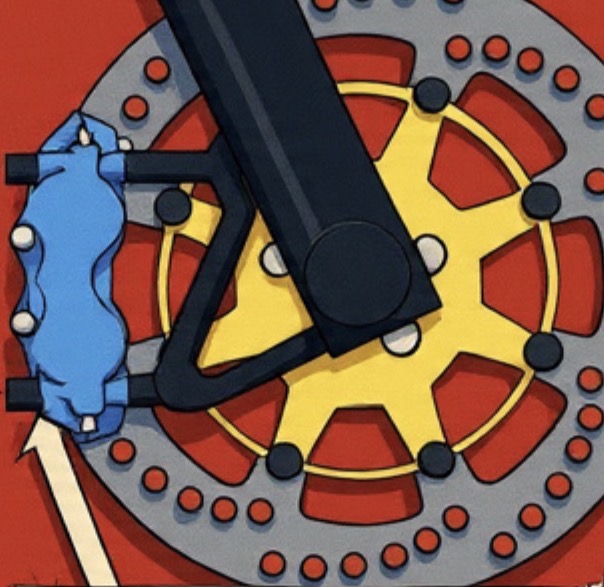
Axial brake calipers are the traditional design and remain the most widely used across the motorcycle industry. In an axial setup, the caliper is mounted to the fork leg using bolts that run across the fork, perpendicular to the brake disc and in the same direction as the axle.
This arrangement has been used for decades due to its simplicity, durability and cost efficiency. During braking, forces are transmitted through the caliper and into the fork via these mounting points. Under very heavy braking, particularly at higher speeds, a small amount of flex can occur as the caliper experiences twisting forces. This flex is generally minimal and does not compromise safety.
Axial brakes are commonly fitted to commuter motorcycles, smaller touring bikes, cruisers and many mid-capacity road machines. For everyday road use, they provide strong, predictable braking performance and are more than capable when correctly maintained.
What Are Radial Motorcycle Brakes?
Radial brake calipers use a different mounting orientation. Instead of bolting across the fork leg, the caliper is secured with bolts that run parallel to the brake disc, extending forwards from the fork towards the centre of the wheel.
This configuration allows braking forces to be transferred more directly into the fork leg. By aligning the load with the mounting bolts, the system resists twisting forces more effectively, resulting in a stiffer overall assembly when braking hard.
Radial brakes were originally developed for racing applications, where consistent braking performance and feedback are essential. Today, they are commonly found on modern sport bikes, performance naked bikes, larger touring bikes and motorcycles designed with fast road or track riding in mind.
Radial vs Axial Brakes: Why Mounting Orientation Matters
Both axial and radial brake systems are capable of producing more braking force than most tyres can transmit to the road. The real difference lies in how the braking system behaves under stress.
With axial calipers, braking forces can introduce rotational stress at the mounting points. With radial calipers, those forces are better aligned with the direction of the bolts, reducing unwanted movement.
In practical terms, radial brakes can offer:
- A firmer and more consistent brake lever feel
- Improved modulation near the limit of tyre grip
- Greater confidence during aggressive braking
These advantages are most noticeable during fast road riding or repeated heavy braking. In normal commuting conditions, the difference is often subtle.
Do Radial Brakes Stop a Motorcycle Faster?
A common misconception is that radial brakes automatically reduce stopping distances. In reality, stopping distance depends primarily on tyre grip, suspension setup, road surface conditions and rider technique.
Radial brakes do not create additional grip. Their main advantage lies in consistency and feedback, particularly during repeated braking from higher speeds. Axial brakes, when properly maintained, are fully capable of delivering excellent braking performance on public roads.
Radial vs Axial Master Cylinders Explained
Brake caliper mounting is only one part of the braking system. Motorcycle brake master cylinders also come in axial and radial designs.
A radial master cylinder positions the piston in line with the direction of lever movement. This can improve hydraulic efficiency and lever feel, particularly during hard braking. In many cases, riders notice a more immediate improvement in braking feel from a master cylinder upgrade than from changing caliper mounting style alone.
It is not uncommon for motorcycles to use radial calipers with axial master cylinders, or vice versa.
Which Motorcycle Brake Setup Is Best for You?
There is no single best option for every rider. The right braking setup depends on how the motorcycle is used.
Axial brakes are well suited to riders who:
- Primarily ride on public roads
- Prioritise reliability and lower maintenance costs
- Do not regularly brake at the limits of tyre grip
Radial brakes are more relevant for riders who:
- Ride aggressively or attend track days
- Value precise brake feel and consistency
- Own performance-oriented motorcycles designed around this system
Both designs are proven, safe and effective when correctly maintained.
Final Thoughts on Radial vs Axial Motorcycle Brakes
Radial brakes should be seen as a refinement rather than a requirement. They offer clear benefits in rigidity and brake feel when riding hard, but they do not fundamentally change how quickly a motorcycle can stop.
For everyday riding, axial brakes remain a sensible and highly capable solution. Radial brakes come into their own when conditions demand repeated, high-load braking where precision, consistency and rider confidence matter most.
Disclaimer: The information provided in this article is for general informational purposes only. While every effort has been made to ensure accuracy, motorcycle models can vary, and manufacturer specifications may differ. Always refer to your motorcycle’s owner’s manual and follow the manufacturer’s recommended procedures and safety guidelines. The author and website assume no responsibility for any damage, injury, or loss resulting from following the guidance in this article.


Leave a Reply