
For many motorcycle YouTubers, the idea of earning money from content sits somewhere between aspiration and curiosity. It is easy to be distracted by stories of viral success, but for most niche creators the path to monetisation is slower, uneven, and far more dependent on consistency than luck.
This post looks at what YouTube actually requires before a channel can earn money, how those requirements apply in practice, and where my own motorcycle channel currently sits. More importantly, it sets a clear baseline before I begin putting more deliberate effort into future content.
How YouTube Monetisation Actually Works
At the time of posting this blog, to earn money directly through YouTube, a channel must be accepted into the YouTube Partner Programme. In recent years, YouTube has introduced a two-stage system designed to give smaller creators access to limited monetisation tools before full advertising revenue becomes available.
The first stage is often referred to as early or entry-level monetisation. To qualify, a channel must have at least 500 subscribers, at least three public uploads within the last 90 days, and must meet one of two performance thresholds. These are either 3,000 valid public watch hours across long-form videos in the last 12 months, or three million valid public Shorts views within the last 90 days.
Reaching this level does not allow ads to be shown on videos. Instead, it unlocks features such as channel memberships, Super Thanks, Super Chats, and other fan-supported tools. For many creators, this is the first indication that YouTube considers the channel suitable for commercial participation.
The second stage is full monetisation. This is where advertising revenue and a share of YouTube Premium income become available. To qualify, a channel must have at least 1,000 subscribers and must meet one of the higher performance thresholds: either 4,000 valid public watch hours in the last 12 months, or ten million valid public Shorts views within a 90-day period.
In addition to meeting these numerical requirements, YouTube also checks that a channel complies with monetisation policies, has no active community guideline strikes, and has basic account security measures such as two-step verification enabled.
Where My Channel Is Right Now
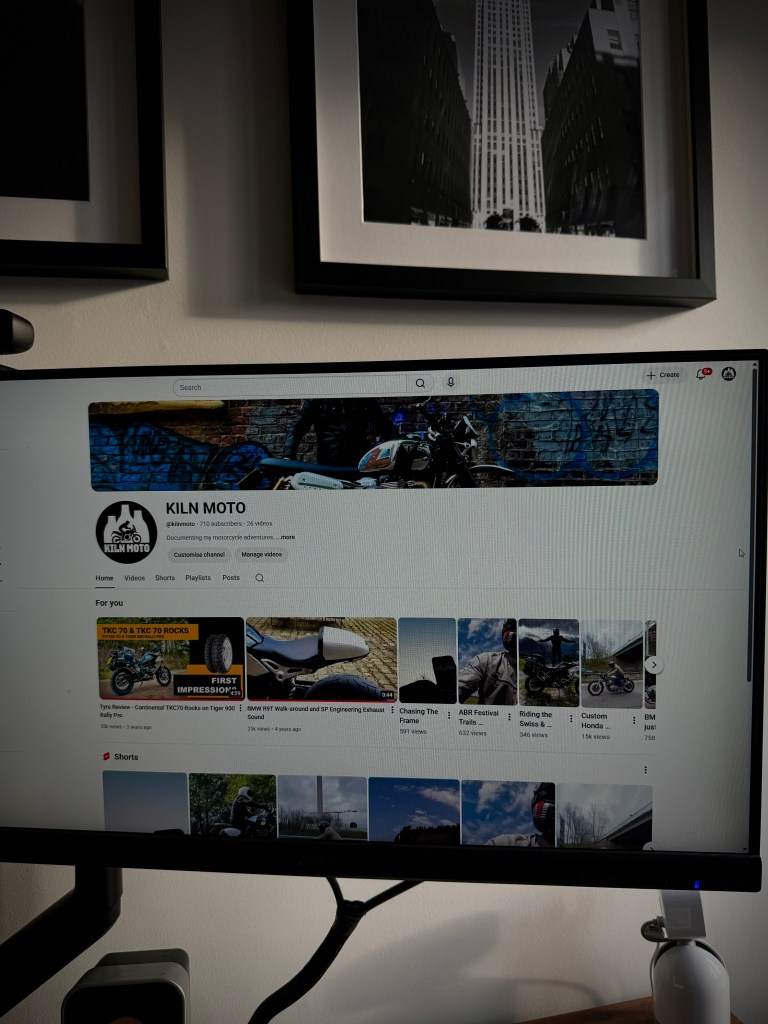
At the time of writing, my KILN MOTO YouTube channel sits at a useful reference point. Over the last 365 days it has recorded 240,262 views. Over its entire lifetime, the channel has accumulated just under 900,000 views.
On the surface, that sounds encouraging. However, the distribution of those views tells a more revealing story.
One YouTube Short Driving the Majority of Views
The bulk of my recent views come from a single Short: a clip of me riding my BMW R9T. Although it was uploaded in 2022, it continues to perform consistently.
In the last year alone, that Short has generated 228,300 views and has reached approximately 750,000 views overall. By contrast, my next most successful Short has achieved just 2,982 views in the last year and around 16,000 views across its entire lifetime.
This shows very clearly that one piece of content is responsible for the vast majority of the channel’s momentum. While it is reassuring to see that a video can continue performing years after publication, it also highlights how fragile the channel’s overall performance currently is.
Long-Form Videos and Watch Hours
Outside of YouTube Shorts, my strongest videos are more traditional long-form motorcycle content. A walkaround of my BMW R9T Walk-around and it’s SP Engineering Exhaust Sound and a Continental TKC 70 tyre review have both passed 20,000 views.
These videos have grown more slowly, but they provide steadier, more predictable performance over time. Crucially, they also contribute significantly to watch hours, which remains one of the most important factors when working towards full monetisation through advertising.
The Gap Before Monetisation
Strong headline view counts aside, there remains a meaningful gap between the channel’s current position and the thresholds required for monetisation. Subscriber growth, sustained watch time, and consistent performance across multiple uploads all need to improve.
That gap matters because it directly informs how I approach the channel if I’m serious about growing it. So far, I haven’t made a deliberate attempt to build a YouTube channel – more a case of posting content sporadically over time. I’m also not depending on YouTube as an income stream, either now or in the near future, which removes a significant amount of pressure. There’s no need to chase trends, optimise purely for the algorithm, or force uploads to meet arbitrary benchmarks.
Instead, the channel has room to evolve organically. I can test different formats, learn what genuinely connects with viewers, and prioritise making content I enjoy creating. If monetisation eventually follows as a by-product of that process, it will be a bonus rather than the goal.
Why This Moment Matters
This stage represents a clear “before” snapshot. So far, effort has been inconsistent and largely unstructured as most of my content is shared via Instagram. Uploads to YouTube have been occasional, Shorts have been experimental, and there has been no defined creative or publishing strategy.
That makes the current data valuable. It shows what the channel looks like when content is created without pressure and without income as the primary goal. As I begin to invest more thought into consistency, storytelling, and direction, any changes in performance should be easy to identify.
What Comes Next
My intention is to focus more on short motorcycle films rather than quick clips alone, placing greater emphasis on atmosphere, riding experience, and visual storytelling. Alongside that, I will continue producing longer-form videos that provide depth and contribute meaningful watch hours.
Over time, it should become clear whether views begin to spread more evenly across uploads and whether success becomes repeatable rather than dependent on a single standout video.
Final Thoughts
YouTube monetisation is achievable for niche creators, but it is rarely quick and almost never linear. The thresholds exist to encourage consistency and quality, not one-off success.
Right now, my channel is still very much in its learning phase. I am not dependent on it financially, and that freedom allows the content to evolve without pressure. What I have at this point is something arguably more valuable: a clear set of data and a realistic baseline from which to build.
Disclaimer:
All YouTube eligibility figures and monetisation requirements referenced in this post reflect publicly available information at the time of writing in January 2026. YouTube’s policies, thresholds, and monetisation rules are subject to change at any time. While every effort has been made to ensure the accuracy of the information presented, the author and this website make no guarantees that the content is complete, current, or free from errors or omissions. The information provided is for general informational purposes only and should not be interpreted as professional, financial, or business advice. Any decisions made by readers or YouTube creators regarding channel growth or monetisation are undertaken at their own risk. The author and this website accept no responsibility or liability for any outcomes, losses, or consequences arising from the use of the information contained in this post.

 KILN MOTO
Leave a comment