
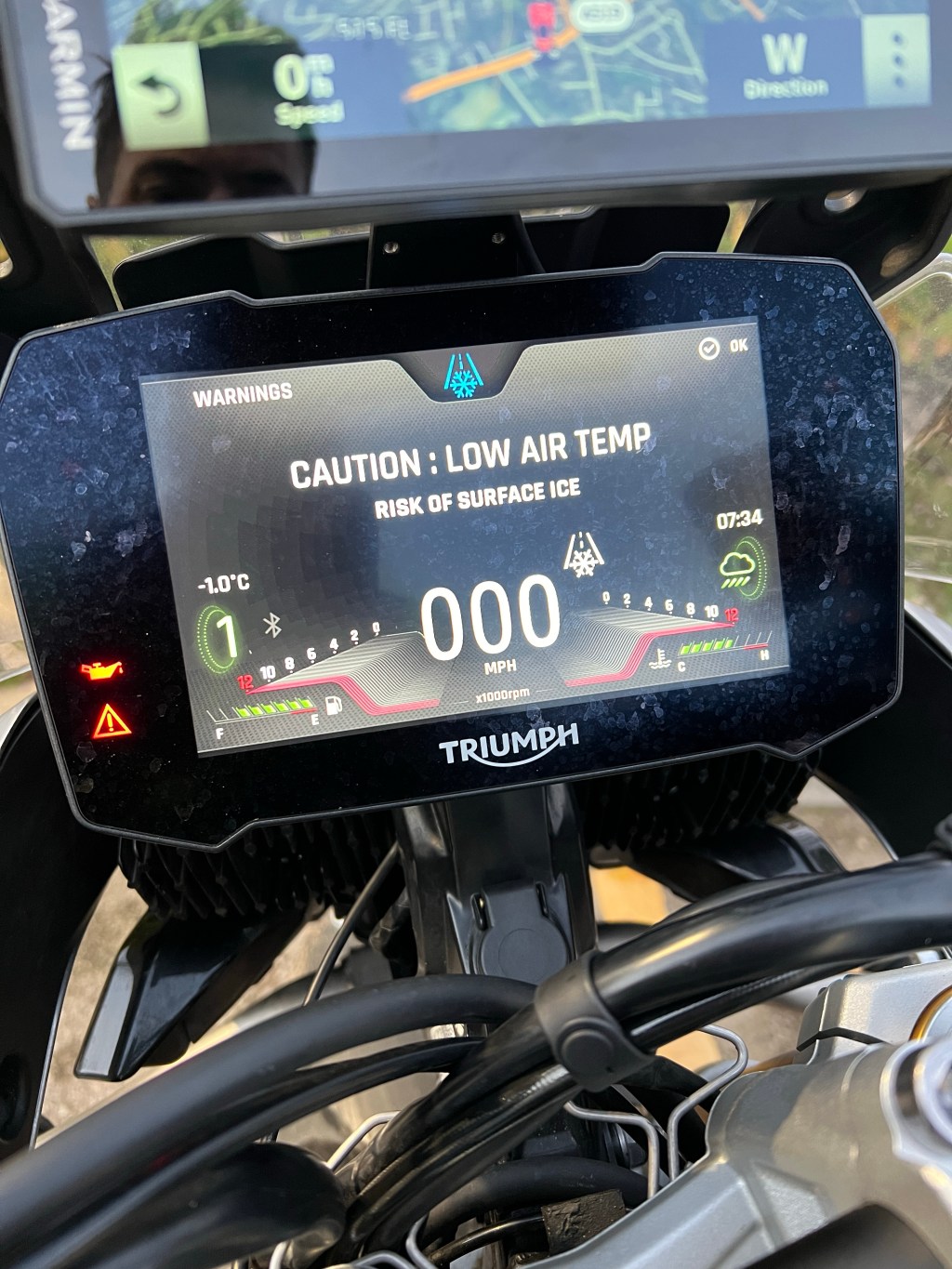
Hey fellow riders! Welcome back to my journey of honing my motorcycle skills. In this edition, I’ll share the highlights of my latest advanced riding lesson, where on a freezing cold Saturday morning I delved into the intricacies of observation, speed management, and the art of staying safe on two wheels.
Eyes wide open
The crux of this lesson revolved around observation skills. The mantra was to scan the road as far down as possible, appreciating all potential hazards that lay ahead. It’s not just about the first obstacle; it’s about looking beyond and selecting the lane that promises the smoothest progress. It’s harder than you’d expect, but with practice the information accrued by scanning further ahead can change your riding style significantly.
Looking for a sign
I found myself needing to pay extra attention to road speed signs and repeaters, especially noting any speed limit reductions. It’s amazing how often we miss these crucial signs, especially when you are familiar with the local road network. The key is to be proactive and anticipate changes rather than react to them. Just give it a go the next time you ride and see just how many signs you can spot.
Giving Room vs. Safety Bubble
One interesting scenario emerged when I erred in judgment. While giving a cyclist plenty of room is a great practice and has been the focus of a safety campaign in the UK, I inadvertently compromised my own safety bubble by getting too close to oncoming traffic. Whilst I did not move into the oncoming traffic lane, I was closer to the white line than I should have been and my observer picked me up on it. It was a valuable lesson in finding the right balance between being considerate to others on the road and maintaining our own safety. Splitting the hazard is one way to address this when there is sufficient space but choosing a better time to overtake when there was no traffic in the other lane would have been safer.
Mastering the Art of Slow Riding
I spent a considerable time focusing on the skill of slow riding in this latest lesson. The challenge was to keep moving as much as possible, minimising the need to put my feet down. It’s a skill that not only enhances control but also boosts confidence, especially in tight situations where slow and steady wins the race. This skill is very useful when approaching traffic lights that are on red, you can slowly approach the lights and keep your bike moving. It also saves you having to stop and do that funny dance we all do, where we find neutral and then change feet to cover the back brake.
Speedo Woes on the Tiger 900 Rally Pro
I discovered a quirk in my Tiger 900 Rally Pro’s speedometer. It seemed to have a penchant for exaggeration, showing a higher speed than I was actually traveling. While it added an element of frustration, it also underscored the importance of being attuned to the feel of the ride rather than relying solely on instrument readings. I have decided to trust my satnav speed reading for now as that one seems a little more accurate than the bike. In a test situation, the need for accuracy on the speed you are travelling is paramount, so I will certainly need to work out how much my speedometer is out at the key speeds and compensate accordingly.
The Power of Regular Practice
As I wrapped up this second lesson, it became evident that regular practice is the key to improvement. We all get into bad habits and become somewhat complacent, so whether it’s refining observation skills, perfecting slow riding, or mastering the nuances of speed management, consistency is the linchpin of progress.
My next ride will be closer to Christmas now, but I’m already looking forward to learning more advanced riding skills.
Until next time – Work hard, ride safe!
KILNmoto

 KILN MOTO
Leave a comment